A Village Fair, Read Through Its Familiar Rituals
Read a village fair through its familiar rituals: notice meeting points, repeated acts and seasonal timing to see what gives this gathering its local shape.
The common mistake at a village fair is to treat its busiest moment as the whole story: admire the stalls, watch the procession, then leave. That misses the quieter clues—who arrives early, where people pause, and which small acts return each year—that reveal how this particular gathering belongs to its place. Reading a village fair through its familiar rituals is less about spotting a grand tradition than noticing what people do together, and when.
A week of attention
You do not need to interview organisers or arrive with a notebook full of theories. A few observations before, during and after the fair can show how its local shape emerges. Keep the focus on visible details, and leave room for customs to vary: one village’s opening bell may be another’s informal first cup of tea.
In the week before the event, check the parish noticeboard, village hall window or local council page for the advertised route, opening arrangements and any explanation of how the fair began. These sources help distinguish a planned feature from something you happen to see. If the programme names a craft display or procession, note its stated purpose without assuming that every resident takes part or attaches the same meaning to it.
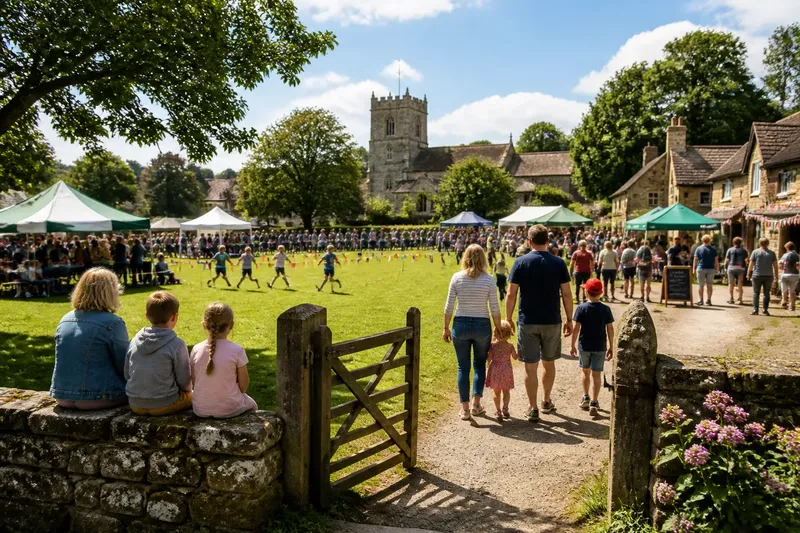
Then look at the place itself. Is the fair held on a green, beside a church, along a high street or across a recreation field? Notice the paths people are likely to use and the points where separate parts of the event meet: a gate, a well-used bench, the corner by the village hall. The fair’s setting is not just a backdrop; it helps explain how people encounter one another.
Before the first stall
Arrive early enough to see the gathering take shape, if the public arrangements allow it. There is no need to enter private spaces or distract people at work. Watch from an ordinary visitor’s route: a stallholder unloading crates, a volunteer checking a table, or neighbours greeting one another can reveal who makes the event possible before it becomes a spectacle.
Look for repeated acts rather than isolated gestures. Do people carry folding chairs to the same patch of grass? Does someone ring a handbell, raise a flag or simply call out that the tea urn is ready? A ritual need not be ancient, formal or announced. It may be a practical action that has become familiar because people expect it and know what to do next.
Notice how the first arrivals use the meeting points. A churchyard gate may bring walkers into the fair; a row of tables may become an informal place to catch up; the edge of the green may suit people who want to watch without joining in. Record the action and setting in plain terms. “Several people stopped by the hall entrance to exchange greetings” is more useful than declaring that the entrance is the village’s symbolic heart.
The fair’s busy hours
Once the event is under way, follow one ordinary route rather than trying to see everything. Walk from entrance to stalls, then towards the main activity and back by a different path. Notice where movement slows, where queues form, and where people linger after buying or watching something. These patterns can show which corners encourage conversation and which serve mainly as thoroughfares.
Pay attention to transitions. A dog show may finish and draw its audience towards refreshments; a short pause between performances may send families towards the stalls. If a procession passes through a familiar street, observe where people gather and whether they rejoin the fair afterwards. The sequence matters: it shows how the event links places that might otherwise feel separate.
Say you visit a fictional fair on a village green, where the programme lists a bell-ringing start and a children’s race. You notice that several families meet by the gate, watch the race from the same low wall, then walk together towards the hall for tea. The useful observation is not that every family follows a custom, but that the gate, wall and hall form a route people can share during the event.
Seasonal timing adds another layer. A fair held in spring may make use of lighter evenings or coincide with a local calendar marker; a summer gathering may centre on the open green. Check what organisers say about timing, then observe how daylight, weather and the working landscape shape the day. Avoid turning a convenient date into a claim about origins unless the evidence supports it.
When plans change
Weather can rearrange the fair’s social map. If rain shifts activities into a hall, notice what transfers easily and what does not: stalls may fit under cover, while a race or procession may be postponed. A change of venue can bring familiar faces into a new meeting point, or divide activities that usually happen side by side. Treat the alteration as part of this year’s story, not as a failure to preserve tradition.
If an advertised activity is cancelled, use the pause to look at what continues. People may still meet for tea, visit the same stalls or make a point of greeting organisers. Equally, a planned ritual may matter chiefly to those who take part, and its absence may pass without comment. Do not infer significance from a single reaction; describe what you can see and leave conclusions open.
It is not worth trying to photograph every participant or collect a quotation from every organiser. A few respectful observations, made from public areas, are better than turning a communal day into a hunt for evidence. If someone explains a custom, ask whether they are comfortable with you repeating the explanation; otherwise, keep your account to the visible event.
After the crowd leaves
Before leaving, take one last look at the places people used. Are chairs stacked near the hall? Has the grass been cleared? Do volunteers remain to pack away, or are visitors still lingering by the gate? These details show the fair as shared work as well as shared entertainment, without suggesting that one person or group speaks for the whole village.
Later that day or the following morning, write down the sequence while it is fresh: where you entered, what happened first, which meeting points recurred, and how the event changed as people moved through it. Separate observation from interpretation. “The handbell sounded before the stalls opened” is an observation; “the bell signals the start of village life” is a much larger claim.
What do fair rituals reveal?
How can I tell a custom from a one-off detail?
Look for an action that returns in the programme, in organisers’ explanations or in the way people anticipate what comes next. A single gesture may simply belong to that day; repetition gives you reason to describe it as familiar, while still avoiding claims that everyone shares its meaning.
What should I notice if I have little time?
Choose one entrance, one gathering point and one transition between activities. Watch how people arrive, where they pause and what they do after the main event. That small route often reveals more about the fair’s local arrangement than a hurried circuit of every stall.
Does every village fair have an old tradition?
No. Some fairs continue a long-running custom, while others are newer gatherings shaped by present-day organisers and practical needs. The event can still express local identity through its setting, shared routines and seasonal place in village life.
How should I describe a custom I cannot explain?
State what you saw, where it happened and when, then say what remains unclear. If you ask someone about it, treat their answer as one person’s account rather than a verdict for the whole village. This keeps the detail useful without inventing an origin story.
A village fair’s familiar rituals are often small enough to miss unless you give them time: a repeated greeting, a well-used gate, the pause between one activity and the next. Read the day in sequence, and its local character becomes easier to describe with care. The clearest account may be a modest one: which places people shared, what they returned to, and what changed when the season or weather changed.