Before the County Museum: Where Local Objects Kept Their Stories
Before the county museum, household collections and local displays kept objects tied to people and place. Learn how to read those clues today.
The most common mistake when tracing a county’s past is to begin with the museum building and assume its collections started there. Before the county museum, objects often sat in homes, schools, inns and meeting rooms, where their stories travelled with the people who handled them. Start with those earlier settings, and a plain tool or scrap of paper can reveal how local memory was kept.
Begin with the object
Choose one object or a small group with a clear local connection: a household account book, a farm implement, a sampler, a shop sign or a fragment of pottery. Note what it is made from, how it was used and what marks it carries. A maker’s stamp, a repaired handle or a name written inside a cover can point towards a person, trade or household.
Keep observation separate from interpretation. “Iron blade, wooden handle, worn near the grip” is a description; “used by a tenant farmer” is a claim that needs support. This distinction matters because objects move: a family heirloom may have arrived in the county long after it was made.
Trace its earlier home
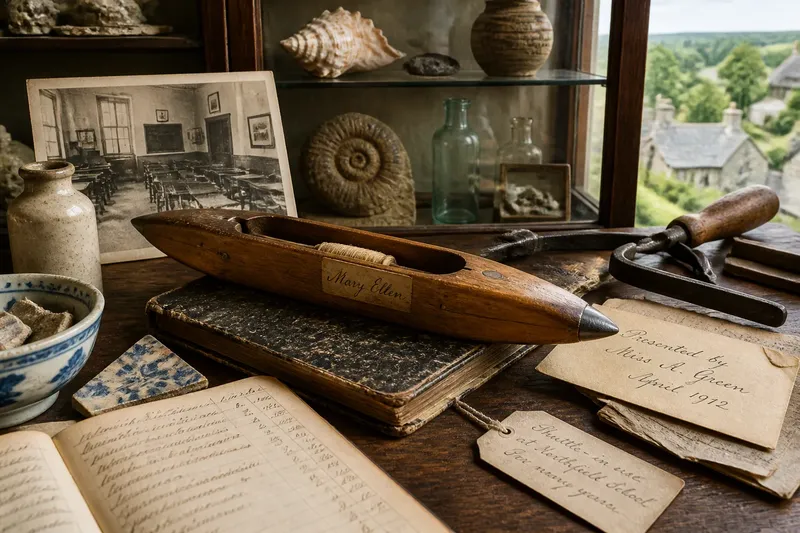
Ask where the object was kept before it entered a public collection. Household cabinets, parlours and studies held curiosities alongside practical belongings. In a schoolroom, a teacher might display local fossils or archaeological finds; in an inn or reading room, a shelf of objects could invite conversation among visitors.
Look for clues in accession registers, donation notes, family papers, old photographs and local newspaper notices. Search under the donor’s name as well as the object type: a record may describe “Mrs Green’s collection” rather than list each item. Local libraries and archives may hold catalogues or correspondence that never made it into a museum’s current object record.
Read the display setting
A display is not simply a container for things. Its location and arrangement can show who was expected to look, what counted as worth preserving and which account of county life was being presented. A glass case in a school suggests a different audience and purpose from a cabinet in a private home.
Notice whether objects were grouped by material, trade, family or locality. Labels may be brief, handwritten or absent; their gaps are clues, too. If a display gathered tools from nearby farms, it may have framed rural work as a shared local inheritance, while a collection of imported shells in a parlour could reflect personal curiosity rather than a formal account of the county.
Follow the people
Identify the collectors, donors, teachers and local organisers attached to the objects. Their occupations and connections help explain how items were gathered and shown. A schoolteacher could collect natural specimens through pupils; a local antiquarian might seek fragments from several parishes; a household might preserve keepsakes because they belonged to a particular family.
Compare names across sources, but do not assume every person with the same surname is related. A donation list may identify a village or household, while a directory or parish record can help distinguish people with similar names. Where the record is thin, describe the link as uncertain rather than turning a possibility into a family story.
Compare the records
Put the object, its earliest known description and its display history side by side. Notice changes in wording: “old iron” might later become a named agricultural tool, or “found near the river” may acquire a more precise location in a later catalogue. Each change can reflect better information, but it can also be an inherited assumption.
Say you find a wooden shuttle with a family label and a note that it once stood in a village school. You could compare the label with a school photograph and a donation register, then record which details agree and which remain uncertain. The observable result is a more careful account: the shuttle’s likely use and display setting are supported, while its maker or exact date remains open.
What should you look for?
What did a household cabinet contain?
It might hold family keepsakes, natural specimens, archaeological fragments, souvenirs or unusual tools. Treat the mix as evidence of the collector’s interests, not as a complete portrait of county life.
How can I find an object’s first display?
Check donation records, local directories, school histories, photographs and newspaper notices for the collector, venue or collection name. A change of venue may be recorded separately from the object’s later museum accession.
Why do old labels use vague descriptions?
Collectors often labelled objects for people who already knew their story, or used everyday terms that later cataloguers could not confidently identify. Preserve the original wording in your notes, then add a modern description separately.
Does an early local display mean a museum existed?
Not necessarily. A temporary exhibition, classroom case or private collection could share objects with visitors without having the staff, permanent premises or collecting policy associated with a museum. Describe the arrangement by what the records show.
Record the limits
Make a compact note for each source: what it says, who created it if known, and what it cannot establish. A donor’s recollection may preserve a valuable family account, but it is not the same kind of evidence as a dated inventory. Keep quotations exact and mark your own interpretation clearly.
Do not spend hours trying to identify every scratch or track down a perfect photograph. If a mark does not connect to a source or change the object’s likely story, record it briefly and move on. The useful work is joining modest clues without making them say more than they can.
Build a local account
Once the trail is assembled, write the account in layers: what the object is; where it was kept; who collected, used or displayed it; and what remains unknown. That order lets readers see how a household collection or local display contributed to the memory later gathered under the county museum’s roof.
For anyone investigating before the county museum, the richest clue may be the relationship between an object and its first audience. A label, a cabinet setting or a school photograph can show not only what people saved, but how they wanted neighbours and children to encounter it. Keep that human setting in view, and the object’s story remains local rather than becoming a loose item in a catalogue.