The Place-Name Shortcut That Leads to the Wrong Conclusion
A place-name shortcut can turn one familiar word into a false origin story. Learn what a name can suggest, what evidence can settle, and when to pause.
The most common place-name mistake is spotting a familiar word, matching it to a landscape or story, and treating the match as an answer. That shortcut can turn a plausible clue into a confident but mistaken claim about who named a place, what its name meant, or how the settlement began. A place-name shortcut is useful for generating questions; it is not a verdict.
The difficulty is that names travel through speech, spelling and administration. A word that looks transparent today may have changed sound, been reshaped by another language, or acquired a spelling that conceals an older form. The right next move depends on what you have: a modern name, a local explanation, a map label, or a string of dated spellings.
Start with your evidence
Before deciding what a name means, identify the kind of evidence in front of you. A road sign records a current form. A local tradition records an interpretation people have carried. A historic document may preserve an older spelling, but its writer could still have heard or copied the name imperfectly.
These sources answer different questions. A present-day sign tells you how the place is named now; it cannot, by itself, tell you how the name began. A story may explain what the name means to residents without proving that this was its original sense.
- Only the modern spelling: treat it as a clue, not an etymology. Look for older spellings before assigning a root.
- A local explanation: preserve it as local knowledge, then ask whether documentary forms support the same reading.
- One old spelling: note its date and context, but do not assume it is the earliest or most faithful form.
- Several forms from different periods: compare how each changes; a sequence is more revealing than an isolated spelling.
- A landscape feature that seems to fit: check whether the feature could have existed when the name arose and whether the name forms point to it.
This is a sorting tool, not a ranking of people’s knowledge. A resident’s account can preserve a pronunciation or association missing from formal records, while an archive can preserve spellings absent from oral memory. The strongest explanation often begins by keeping these kinds of evidence distinct.
When a word looks familiar
If one part of a name resembles an ordinary English word, resist the urge to split the whole name around it. Sound-alike forms are common, and spelling can make unrelated words look like close relatives. A modern reader may see a familiar term where an older speaker heard something quite different.
Ask whether the apparent root behaves consistently across the name’s older forms. Does it appear in the same position, with changes that could plausibly follow local speech? Does the rest of the name make sense alongside it? If the answer depends on ignoring awkward letters or inventing a sound change for this one place alone, the reading needs stronger support.
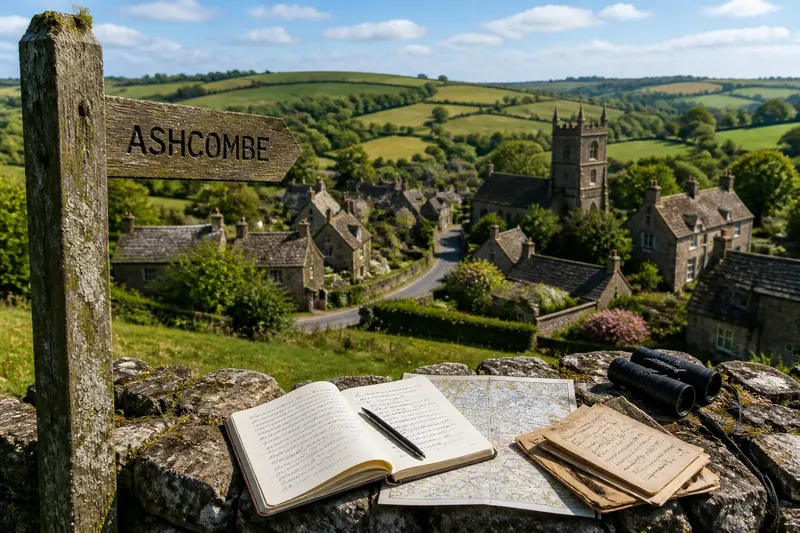
Imagine you find a hamlet called Ashcombe and assume the first part must refer to ash trees because ash grows nearby. That is a reasonable question, not a settled origin: you would next check early spellings, the local pronunciation, and whether the full name’s elements fit together. If those forms point towards a different root, the tree-based reading should remain a folk explanation rather than be presented as fact.
What is not worth the effort is chasing every resemblance in a dictionary or online word list. A long list of possible roots does not make an argument stronger; it usually makes the boundary between evidence and guesswork harder to see.
When the landscape seems decisive
A hill, stream, wood or marsh can make a name feel self-explanatory. Yet landscapes change, and features that look prominent now may not have been named or visible when the place-name took shape. A modern field boundary or planted copse is especially weak evidence for an old name unless the historical record connects them.
Start by asking what the proposed feature actually is and whether it could account for the name’s older form. A river name may outlast changes in its course or banks; a name for a slope might describe land beyond the village’s current edge. The place named and the feature named are not always the same thing.
Maps can help locate a proposed feature, but a map label is not automatically an explanation. Check whether the label is older than the claim, whether it appears on independent maps, and whether it might itself have been copied from a misunderstanding of the place-name. Circular reasoning is easy: a name is said to refer to a feature because the map labels it that way, while the label is assumed to be correct because it matches the name.
When a local story matters
A story about a founder, battle, trade or unusual event can be part of a place’s identity even when it cannot explain the name’s origin. Keep those two claims separate. “People here tell a story that…” reports a tradition; “the name comes from…” makes a historical claim that needs evidence of its own.
That distinction does not make local accounts disposable. They can preserve older pronunciations, explain why a particular interpretation became popular, or point towards a record worth seeking. Ask who tells the story, what details remain stable, and whether anyone remembers when it began circulating.
If you are writing a caption or giving a short local talk, say what is known and mark the uncertainty plainly. “The name is often linked locally with the old ford, though early spellings would be needed to confirm the connection” gives listeners both the living explanation and its limits. It is more informative than turning a cherished account into a proven origin.
Which source should you follow?
What if I have only a sign or postcode?
Use the modern form as a starting point, then seek historic spellings in local maps, parish records or place-name references. Until you find a sequence of forms, describe the proposed meaning as a possibility rather than a conclusion.
What if the name has two possible roots?
Compare each explanation against the dated spellings, local pronunciation and the full structure of the name. Prefer the reading that accounts for more evidence with fewer special assumptions, and leave the answer open if both remain plausible.
What if neighbours disagree?
Record the different explanations without forcing a vote. Ask whether each is an account of the name’s origin, a later story attached to it, or a description of what the place means to residents now.
When should I ask a specialist?
Consult a county place-name volume, local archive staff or an onomastics specialist when the older forms are difficult to interpret or the claim will be published as fact. Their value is not simply a definitive-sounding answer; it is a reasoned account of which forms support which reading.
When spellings disagree
Older documents often use spellings that vary between writers, and a name may be recorded in a Latinised form, a clerk’s approximation or a version shaped by another language. Do not treat every changed letter as evidence of a changed meaning. Look for recurring patterns and consider who wrote each form, for what purpose and in what language.
Build a small chronology rather than gathering forms without order. Note the date, source and spelling, then mark what appears stable and what shifts. A parish register, estate map and official record may have been produced for different audiences; agreement across independent sources is more persuasive than repeated copying from one source.
Local pronunciation belongs in that comparison. A name spoken by residents may preserve a sound that official spelling has flattened, while a spelling may preserve a distinction that is no longer audible. Ask speakers to say the name naturally, but do not assume that current pronunciation alone can reconstruct a distant past.
Choosing a careful conclusion
Match the strength of your wording to the strength of your evidence. With only a modern spelling, say that a reading is suggested by the name’s present form. With a local tradition, attribute it. With a well-supported sequence of early spellings and a coherent linguistic explanation, you can state a stronger conclusion while still noting genuine uncertainty.
For example, a notice about a place called Brookfield might say that residents connect the name with a stream beside the settlement. If old spellings consistently support that reading, the notice can explain why; if they do not, it can present the stream as a local association rather than the source. The useful result is not a forced verdict but a clear account of what the evidence can bear.
For any place-name shortcut, the practical test is simple: does the explanation account for the name’s older forms, its sounds and its context, or does it merely fit one modern-looking word? Follow the evidence that survives those questions, and keep the rest as a possibility, a tradition or an open question. That precision lets a place keep its stories without mistaking every story for its origin.